
FAQs
About the Study
What is an MCEA process?
An MCEA is a Municipal Class Environmental Assessment. This study falls under Schedule C Phases 1 through 4 which includes Identifying the Problem or Opportunity, Developing Alternative Solutions to address the problems and opportunities, Developing Alternative Design Concepts for the Preferred Solution, and preparing an Environmental Study Report.
To learn more about the MCEA process, visit municipalcalssea.ca
When is the study happening?
The study started in June 2025 and is targeted to be completed by the end of 2026
What is the area of the study?
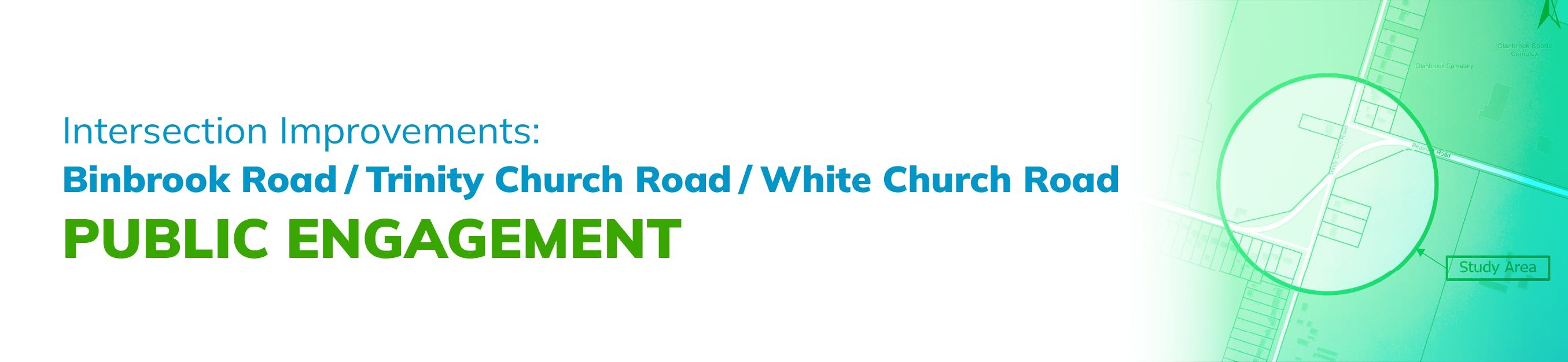
The intersection of Binbrook Road, Trinity Church Road and White Church Road.
What is the scope of the project?
The project will examine pedestrian, cyclist, and traffic concerns for safety and operation of the intersection and evaluate transportation improvement options including (but not limited to) realignment of the intersections and implementation of design alternatives such as a roundabout, signals or stop control at the intersections of Binbrook Road, Trinity Church Road and White Church Road.
Will neighbouring properties be impacted by the study?
The proposed improvements to the transportation infrastructure will be focused on the public right-of-way (ROW). However, if the existing ROW is too narrow on some sections of the road, we will investigate opportunities to modify the cross-section so it can be accommodated on public property. Should this not be feasible, the project team will ensure early and thorough communication with impacted property owners.
Climate Change
How will this project support Climate Change?
The focus of this study is to assess options to improve active transportation, transit, traffic, and stormwater management throughout the corridor. Through the improvements to active transportation and transit (new route will be added to support Route 27 from Upper James), the public will have better access to additional transportation opportunities throughout the corridor, reducing the quantity of motor vehicle travel. Overall, this shift in transportation methods will help to reduce greenhouse gas emissions. In addition, stormwater management improvements will increase resiliency to climate change events, such as extreme rainfall. The measures implemented as part of the project will better manage stormwater run-off and reduce the risk of flooding.
Natural Environment
How will the project consider the natural environment
As part of the environmental assessment study, an inventory of the existing natural environment in the area will be completed through field investigations, background research and consultation with the Niagara Peninsula Conservation Authority. A Natural Heritage Assessment Report will be prepared to summarize the findings.
How many trees will be removed?
Tree removal may be required as part of this project. At this time, the potential quantity of tree removal is not known, but impacts to the trees will be avoided and mitigated to the extent possible. As part of the study, opportunities for streetscaping and landscaping improvements will be taken into consideration where feasible.
Noise & Construction
When will construction start?
The environmental assessment study is scheduled for completion by the end of 2026. If endorsed by Council and there are no outstanding issues with the study, then detailed design work can begin. It is anticipated that detailed design would take approximately 2 to 3 years. Tender of construction would be able to occur once detailed design is complete. The timing of both detailed design and construction are subject to change depending on the road reconstruction program and other coordinated works.
I'm concerned about increased traffic-related noise as a result of the intersection realignment. What will be done to mitigate noise impacts?
A Noise Assessment Study is being undertaken as part of the study. The findings will be presented as the study progresses, including the need for noise mitigation measures (i.e. noise barriers, landscaping, etc.). The noise assessment will use current and projected future traffic data to model the sound levels caused by road traffic with and without the proposed improvements.
Traffic & Safety
Will there be signal lights?
Roundabouts/traffic signals (signalization)/stop control will be considered as part of the alternative design options in the next phase study.
Will rumble strips, flashing warning lights, lighting, and clear turn signals be implemented?
Traffic calming measures will be considered in the detailed design phase following the MCEA study.