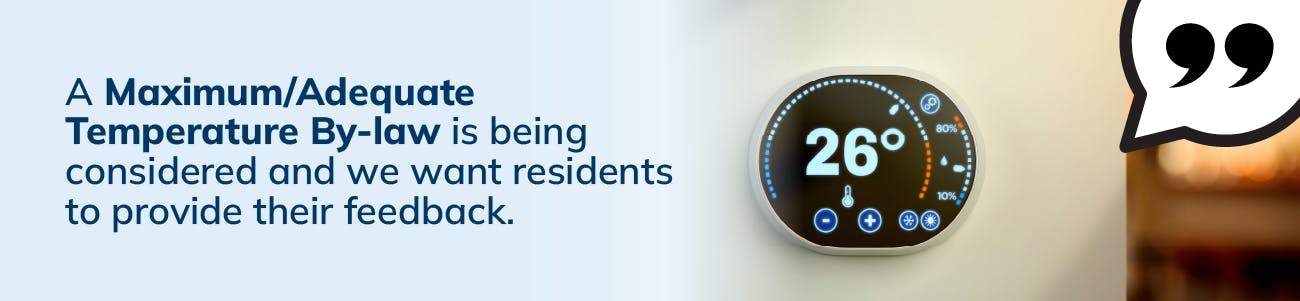
Maximum/Adequate Temperature By-law

Share Maximum/Adequate Temperature By-law on Facebook Share Maximum/Adequate Temperature By-law on Twitter Share Maximum/Adequate Temperature By-law on Linkedin Email Maximum/Adequate Temperature By-law link

In May 2023, Hamilton's City Council directed staff in Licensing and By-law Services to explore potential options for the development and introduction of a Maximum or Adequate Temperature By-law, which would impose a maximum indoor temperature of 26°C in rental units, during the warmer summer months.

What is an Adequate Temperature By-law and why is it important?

Across Canada, communities are experiencing the impacts of climate change and extreme temperatures. The City of Hamilton Climate Science Report has predicted that the number of consecutive days with temperatures exceeding 30°C will increase and that heat waves will be more frequent. Research has identified increases in the likelihood of temperature-related deaths with future climate change impacts and the need for urgent action. While extreme temperatures are occurring more regularly, the unpredictability of when temperature fluctuations may occur has also increased. As a result, some municipalities (including the City of Hamilton) are exploring the feasibility of developing a by-law that would impose a maximum temperature in rental units.

An Adequate Temperature By-law would impose a maximum indoor temperature of 26°C in rental units, during summer months. Under a broad Maximum or Adequate Temperature By-law, property owners/landlords could be required to ensure that cooling equipment is available/installed where the temperature in rental units exceed 26°C.

A proposed Maximum or Adequate Temperature By-law would need to consider this legislation:

  • Residential Tenancies Act (RTA) - Currently, the RTA does not include cooling as a vital service. Property owners/landlords are only required to ensure that heat, hot or cold water, fuel, electricity and/or gas are maintained during specific timeframes. At this time, the RTA does not include language to allow tenants to install window or portable air conditioners. In 2023, the Ontario government passed Bill 97 Helping Homebuyers, Protecting Tenants Act which introduced amendments to the RTA to allow tenants to install window or portable air conditions in most situations. However, the legislation has not been proclaimed by the Provincial government and is of no force or effect at this time.
  • Property Standards By-law No. 23-162 - In September 2025, the Property Standards By-law was amended to include new language around cooling appliances. Specifically, the By-law requires that in situations where a property owner/landlord is responsible for providing cooling appliances or where cooling appliances are provided, that a property owner/landlord ensure that cooling appliances remain in a state of good repair.

What are we looking to learn as part of this engagement?

We want to hear from you about:

  • Whether a maximum/adequate temperature by-law should be imposed and the importance of landlord provided cooling
  • Learn about public knowledge and awareness respecting existing legislation, support programs and the implications of a proposed maximum/adequate temperature by-law
  • Explore public feedback on a suite of options around cooling, which may include; a maximum/adequate temperature by-law or cooling rooms
  • Learn the benefits and challenges of a proposed maximum temperature by-law

How can you participate?

We are inviting tenants, landlords and anyone interested or impacted by the development of an Maximum/Adequate Temperature By-law to participate in a survey that will help inform the proposed by-law recommendations that may be included in a report to Council in 2026.

In May 2023, Hamilton's City Council directed staff in Licensing and By-law Services to explore potential options for the development and introduction of a Maximum or Adequate Temperature By-law, which would impose a maximum indoor temperature of 26°C in rental units, during the warmer summer months.

What is an Adequate Temperature By-law and why is it important?

Across Canada, communities are experiencing the impacts of climate change and extreme temperatures. The City of Hamilton Climate Science Report has predicted that the number of consecutive days with temperatures exceeding 30°C will increase and that heat waves will be more frequent. Research has identified increases in the likelihood of temperature-related deaths with future climate change impacts and the need for urgent action. While extreme temperatures are occurring more regularly, the unpredictability of when temperature fluctuations may occur has also increased. As a result, some municipalities (including the City of Hamilton) are exploring the feasibility of developing a by-law that would impose a maximum temperature in rental units.

An Adequate Temperature By-law would impose a maximum indoor temperature of 26°C in rental units, during summer months. Under a broad Maximum or Adequate Temperature By-law, property owners/landlords could be required to ensure that cooling equipment is available/installed where the temperature in rental units exceed 26°C.

A proposed Maximum or Adequate Temperature By-law would need to consider this legislation:

  • Residential Tenancies Act (RTA) - Currently, the RTA does not include cooling as a vital service. Property owners/landlords are only required to ensure that heat, hot or cold water, fuel, electricity and/or gas are maintained during specific timeframes. At this time, the RTA does not include language to allow tenants to install window or portable air conditioners. In 2023, the Ontario government passed Bill 97 Helping Homebuyers, Protecting Tenants Act which introduced amendments to the RTA to allow tenants to install window or portable air conditions in most situations. However, the legislation has not been proclaimed by the Provincial government and is of no force or effect at this time.
  • Property Standards By-law No. 23-162 - In September 2025, the Property Standards By-law was amended to include new language around cooling appliances. Specifically, the By-law requires that in situations where a property owner/landlord is responsible for providing cooling appliances or where cooling appliances are provided, that a property owner/landlord ensure that cooling appliances remain in a state of good repair.

What are we looking to learn as part of this engagement?

We want to hear from you about:

  • Whether a maximum/adequate temperature by-law should be imposed and the importance of landlord provided cooling
  • Learn about public knowledge and awareness respecting existing legislation, support programs and the implications of a proposed maximum/adequate temperature by-law
  • Explore public feedback on a suite of options around cooling, which may include; a maximum/adequate temperature by-law or cooling rooms
  • Learn the benefits and challenges of a proposed maximum temperature by-law

How can you participate?

We are inviting tenants, landlords and anyone interested or impacted by the development of an Maximum/Adequate Temperature By-law to participate in a survey that will help inform the proposed by-law recommendations that may be included in a report to Council in 2026.

  • We invite tenants and anyone interested or impacted by the development of an Maximum/Adequate Temperature By-law to participate in this survey to help inform the proposed by-law recommendations that may be included in a report to Council in 2026.

    Notice of Collection: The City of Hamilton collects information under authority of Sections 10 and 227 of the Municipal Act, 2001. Any personal information collected for the Adequate Temperature By-Law Survey will be used for this intended to be used to inform potential recommendations to establish an Adequate Temperature By-law. By providing your email address, you are consenting to receiving emails from the City of Hamilton and/or their agents/contractors for purposes related to this survey. Questions about the collection of this personal information can be directed to the Project Manager, Licensing and By-law Services, Planning and Economic Development Department, 330 Wentworth St. N., Hamilton, ON, 905-546-2424 Ext. 4928, Aleah.Whalen@hamilton.ca and/or the Manager of Policy and Programs, Licensing and By-law Services, Planning and Economic Development Department, 330 Wentworth St. N., Hamilton, ON, 905-546-2424 Ext. 2348, Gillian.Barkovich@hamilton.ca.

    Take Tenant Survey
    Share Tenant Survey on Facebook Share Tenant Survey on Twitter Share Tenant Survey on Linkedin Email Tenant Survey link
  • We invite landlords interested or impacted by the development of an Maximum/Adequate Temperature By-law to participate in this survey to help inform the proposed by-law recommendations that may be included in a report to Council in 2026.

    Notice of Collection: The City of Hamilton collects information under authority of Sections 10 and 227 of the Municipal Act, 2001. Any personal information collected for the Adequate Temperature By-Law Survey will be used for this intended to be used to inform potential recommendations to establish an Adequate Temperature By-law. By providing your email address, you are consenting to receiving emails from the City of Hamilton and/or their agents/contractors for purposes related to this survey. Questions about the collection of this personal information can be directed to the Project Manager, Licensing and By-law Services, Planning and Economic Development Department, 330 Wentworth St. N., Hamilton, ON, 905-546-2424 Ext. 4928, Aleah.Whalen@hamilton.ca and/or the Manager of Policy and Programs, Licensing and By-law Services, Planning and Economic Development Department, 330 Wentworth St. N., Hamilton, ON, 905-546-2424 Ext. 2348, Gillian.Barkovich@hamilton.ca.

    Take Landlord Survey
    Share Landlord Survey on Facebook Share Landlord Survey on Twitter Share Landlord Survey on Linkedin Email Landlord Survey link
Page last updated: 22 Jan 2026, 03:12 PM