
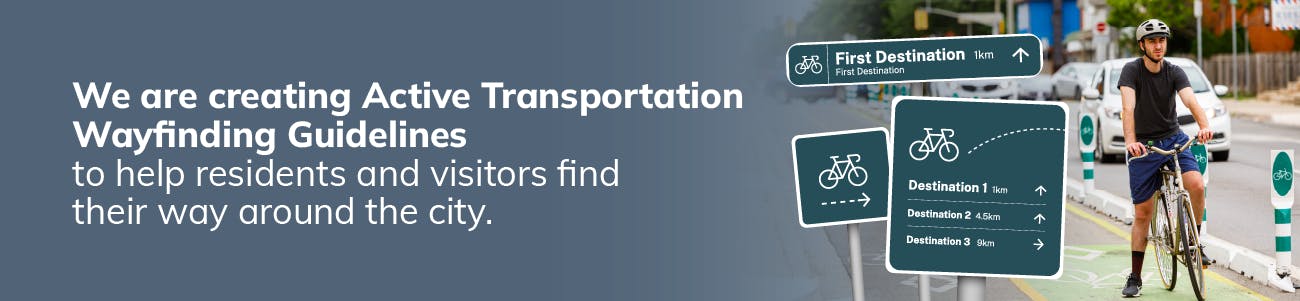
Active Transportation Wayfinding Guidelines
Active transportation wayfinding plays a crucial role in improving navigation and enriching the experience for all users, including cyclists and pedestrians. By providing clear signage and route markers, it helps people locate key destinations, plan efficient routes, and stay oriented during their journeys. Thoughtful wayfinding fosters a connected and accessible community, making active travel a seamless part of daily life.
What Are We Doing?
We are creating a Hamilton Active Transportation Wayfinding Strategy to improve signs and information that help residents and visitors make their way around the city. This ease of navigation boosts confidence, encourages exploration, and promotes walking and cycling as safe, reliable, and enjoyable modes of transportation.
We aim to develop an effective wayfinding system that will:
- Help residents and visitors plan their trips
- Estimate their travel time
- Choose the best routes for their needs
- Find their destination efficiently
What Are We Looking To Learn From Community?
We're seeking community input on:
- Major destinations that should be featured on signage
- Key decision points where users need directional guidance Information that helps you feel confident when navigating Hamilton on foot or by bike
Input received during public engagement will help to inform the draft strategy.
What We Heard
The City of Hamilton’s Sustainable Mobility team conducted public engagement to understand how people navigate Hamilton’s active transportation network and what type of wayfinding support they need. Engagement focused on identifying barriers, signage preferences, navigation priorities, and destination needs for walking, cycling, rolling, and trail use. The engagement program included digital and in-person activities, targeting both frequent active transportation users and residents with varying mobility needs.
-

Email evan.nopper@hamilton.ca -

-


Engagement Level: Consult
Our Commitment: Staff will get your feedback on the project/initiative.
We promise to:
- Keep you informed.
- Listen to and acknowledge your concerns or hopes for the project.
- Provide feedback to you on how the input received was used to inform the project.