We use cookies to ensure our site functions properly and to store limited information about your usage. You may give or withdraw consent at any time.To find out more, read our privacy policy and cookie policy.
Manage Cookies
A cookie is information stored on your computer by a website you visit. Cookies often store your settings for a website, such as your preferred language or location. This allows the site to present you with information customized to fit your needs. As per the GDPR law, companies need to get your explicit approval to collect your data. Some of these cookies are ‘strictly necessary’ to provide the basic functions of the website and can not be turned off, while others if present, have the option of being turned off. Learn more about our Privacy and Cookie policies. These can be managed also from our cookie policy page.
Strictly necessary cookies(always on):
Necessary for enabling core functionality. The website cannot function properly without these cookies. This cannot be turned off. e.g. Sign in, Language
Analytics cookies:
Analytical cookies help us to analyse user behaviour, mainly to see if the users are able to find and act on things that they are looking for. They allow us to recognise and count the number of visitors and to see how visitors move around our website when they are using it. Tools used: Google Analytics
Harmonized Private Tree By-law, Updates to existing Woodland bylaws and Tree Protection Guidelines
Share Harmonized Private Tree By-law, Updates to existing Woodland bylaws and Tree Protection Guidelines on FacebookShare Harmonized Private Tree By-law, Updates to existing Woodland bylaws and Tree Protection Guidelines on TwitterShare Harmonized Private Tree By-law, Updates to existing Woodland bylaws and Tree Protection Guidelines on LinkedinEmail Harmonized Private Tree By-law, Updates to existing Woodland bylaws and Tree Protection Guidelines link
In 2023, the Urban Forest Strategy was approved by Council – within the strategy is a target to grow the urban forest canopy to 40% by 2050. To help achieve this staff were directed to develop and seek public feedback on a Harmonized Private Tree Bylaw which would apply to the urban boundary only. Staff were also directed to update the existing Woodland Bylaws (regional and urban) and Tree Protection Guidelines, which apply to developments of 10 units or greater.
How do Bylaws help grow the urban canopy?
Approximately 58% (5.2 million) of Hamilton’s trees are located on private property. Between 2021 and 2024, within the urban boundary, Hamilton has continued to lose tree canopy on private land. The Bylaws and Guidelines directly support the retention of trees on private property and increased compensation for trees removed.
What size of tree is the Bylaw proposing to protect?
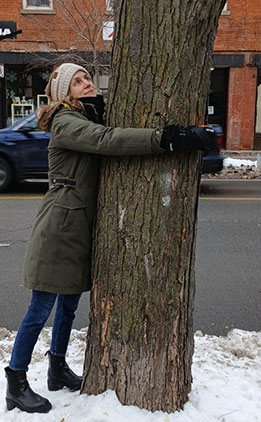
A 45cm tree or greater on private property measured at 1.4m off the ground, known is the arboriculture industry as diameter at breast height.
Person hugging 45cm diameter tree at breast height
What are the impacts to me as resident?
The proposed Private Tree Bylaw will impact homeowners, as tree removals that meet the size threshold and do not meet an exemption will require a permit fee and the planting of replacement tree(s), creating additional costs for residents. The expanded list of exemptions is designed to limit these costs by ensuring trees removed for valid reasons are exempt, while preserving safe, healthy trees that contribute to the urban canopy.
Review Draft Bylaws & Guidelines
Review the draft Harmonized Private Tree By-law and proposed updates to the Urban Woodland By-law, Woodland Conservation By-Law, and Tree Protection Guidelines:

In 2023, the Urban Forest Strategy was approved by Council – within the strategy is a target to grow the urban forest canopy to 40% by 2050. To help achieve this staff were directed to develop and seek public feedback on a Harmonized Private Tree Bylaw which would apply to the urban boundary only. Staff were also directed to update the existing Woodland Bylaws (regional and urban) and Tree Protection Guidelines, which apply to developments of 10 units or greater.
How do Bylaws help grow the urban canopy?
Approximately 58% (5.2 million) of Hamilton’s trees are located on private property. Between 2021 and 2024, within the urban boundary, Hamilton has continued to lose tree canopy on private land. The Bylaws and Guidelines directly support the retention of trees on private property and increased compensation for trees removed.
What size of tree is the Bylaw proposing to protect?
A 45cm tree or greater on private property measured at 1.4m off the ground, known is the arboriculture industry as diameter at breast height.
Person hugging 45cm diameter tree at breast height
What are the impacts to me as resident?
The proposed Private Tree Bylaw will impact homeowners, as tree removals that meet the size threshold and do not meet an exemption will require a permit fee and the planting of replacement tree(s), creating additional costs for residents. The expanded list of exemptions is designed to limit these costs by ensuring trees removed for valid reasons are exempt, while preserving safe, healthy trees that contribute to the urban canopy.
Review Draft Bylaws & Guidelines
Review the draft Harmonized Private Tree By-law and proposed updates to the Urban Woodland By-law, Woodland Conservation By-Law, and Tree Protection Guidelines:
Notice of Collection: The City of Hamilton collects your information under the authority of Sections 227 of the Municipal Act for the purpose of Harmonized Private Tree Bylaw Review and Updates to Existing Woodland Bylaws and Existing Tree Protection Guidelines. Your opinion collected will be used to inform the development of recommendations to City Council as part of the Harmonized Private Tree Bylaw Review and the updates to existing Woodland Bylaws and Tree Protection Guidelines. Questions about this collection should be directed to: Senior Project Manager, Policy & Preservation 100 King St W, 14th Floor, Hamilton, ON, L8P 1A2, 365-384-0204, louise.thomassin@hamilton.ca
Share Private Tree Protection Survey on FacebookShare Private Tree Protection Survey on TwitterShare Private Tree Protection Survey on LinkedinEmail Private Tree Protection Survey link
Notice of Collection: The City of Hamilton collects your information under the authority of Sections 227 of the Municipal Act for the purpose of Harmonized Private Tree Bylaw Review and Updates to Existing Woodland Bylaws and Existing Tree Protection Guidelines. Your opinion collected will be used to inform the development of recommendations to City Council as part of the Harmonized Private Tree Bylaw Review and the updates to existing Woodland Bylaws and Tree Protection Guidelines. Questions about this collection should be directed to: Senior Project Manager, Policy & Preservation 100 King St W, 14th Floor, Hamilton, ON, L8P 1A2, 365-384-0204, louise.thomassin@hamilton.ca