We use cookies to ensure our site functions properly and to store limited information about your usage. You may give or withdraw consent at any time. To find out more, read our privacy policy and cookie policy.
Manage Cookies
A cookie is information stored on your computer by a website you visit. Cookies often store your settings for a website, such as your preferred language or location. This allows the site to present you with information customized to fit your needs. As per the GDPR law, companies need to get your explicit approval to collect your data. Some of these cookies are ‘strictly necessary’ to provide the basic functions of the website and can not be turned off, while others if present, have the option of being turned off. Learn more about our Privacy and Cookie policies. These can be managed also from our cookie policy page.
Strictly necessary cookies(always on):
Necessary for enabling core functionality. The website cannot function properly without these cookies. This cannot be turned off. e.g. Sign in, Language
Analytics cookies:
Analytical cookies help us to analyse user behaviour, mainly to see if the users are able to find and act on things that they are looking for. They allow us to recognise and count the number of visitors and to see how visitors move around our website when they are using it. Tools used: Google Analytics
Binbrook/Trinity/White Church Road Intersection Improvements EA
Share Binbrook/Trinity/White Church Road Intersection Improvements EA on FacebookShare Binbrook/Trinity/White Church Road Intersection Improvements EA on TwitterShare Binbrook/Trinity/White Church Road Intersection Improvements EA on LinkedinEmail Binbrook/Trinity/White Church Road Intersection Improvements EA link
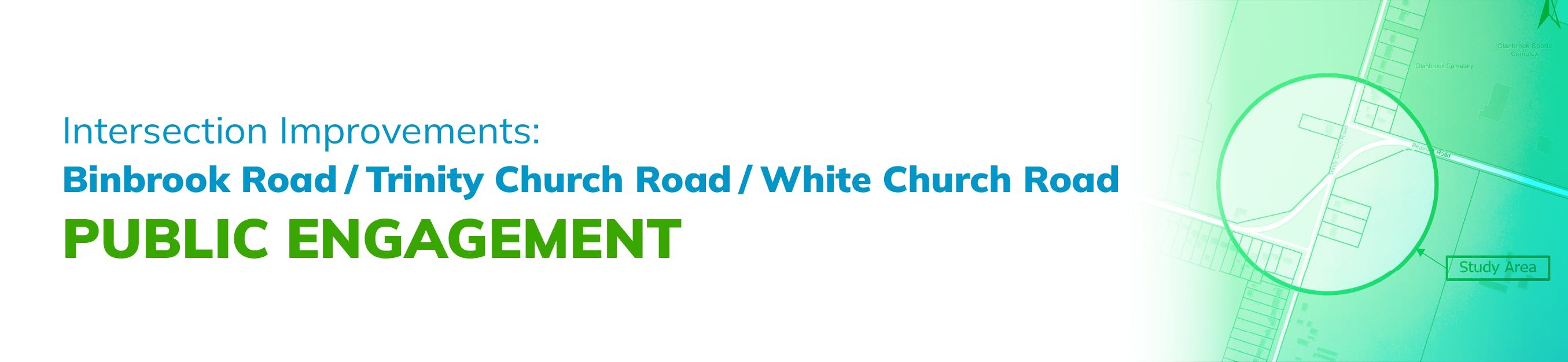
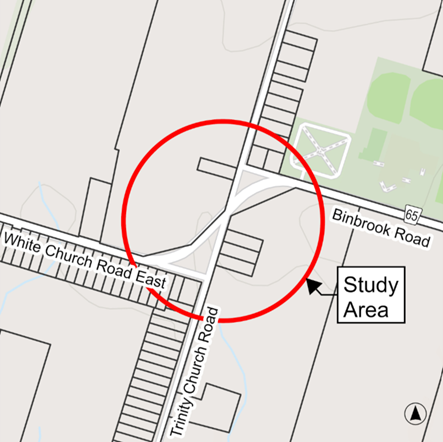
The City of Hamilton has started a Municipal Class Environmental Assessment (MCEA) to look at ways to improve the intersection at Binbrook Road, Trinity Church Road, and White Church Road in Glanbrook, Ward 11.
An Environmental Assessment (EA) is a planning process used across Ontario to study potential impacts of infrastructure projects on the community and environment.
A Municipal Class Environmental Assessment (MCEA) is a specific type of EA designed for municipal road, water, wastewater, and transit projects.
Public engagement is key to the MCEA and EA process, ensuring residents are both informed and consulted throughout the lifecycle of the project.
What is our goal for this project?
This study will:
Review traffic, pedestrian, and cycling safety at the intersection.
Assess how well the intersection operates today and in the future.
Explore improvement options, such as building a roundabout, inclusion of active transportation features, or other changes to make the intersection safer and more efficient.
What do we want to learn?
To help shape decisions for this project, we’d like to hear your feedback on:
Concerns about intersection safety
How you prefer to walk, bike, or get around (active transportation)
Your preferences for new landscaping features
Your thoughts on the proposed intersection design concepts
How can you get involved in shaping this project?
We are committing to consulting residents as part of this project to inform preferred design options for the intersection.
We invite residents to share feedback using Engage Hamilton and during our in-person community meetings to help shape upcoming enhancements. Please use this platform to explore what we're planning, let us know what you think, and ask questions.
The City of Hamilton has started a Municipal Class Environmental Assessment (MCEA) to look at ways to improve the intersection at Binbrook Road, Trinity Church Road, and White Church Road in Glanbrook, Ward 11.
An Environmental Assessment (EA) is a planning process used across Ontario to study potential impacts of infrastructure projects on the community and environment.
A Municipal Class Environmental Assessment (MCEA) is a specific type of EA designed for municipal road, water, wastewater, and transit projects.
Public engagement is key to the MCEA and EA process, ensuring residents are both informed and consulted throughout the lifecycle of the project.
What is our goal for this project?
This study will:
Review traffic, pedestrian, and cycling safety at the intersection.
Assess how well the intersection operates today and in the future.
Explore improvement options, such as building a roundabout, inclusion of active transportation features, or other changes to make the intersection safer and more efficient.
What do we want to learn?
To help shape decisions for this project, we’d like to hear your feedback on:
Concerns about intersection safety
How you prefer to walk, bike, or get around (active transportation)
Your preferences for new landscaping features
Your thoughts on the proposed intersection design concepts
How can you get involved in shaping this project?
We are committing to consulting residents as part of this project to inform preferred design options for the intersection.
We invite residents to share feedback using Engage Hamilton and during our in-person community meetings to help shape upcoming enhancements. Please use this platform to explore what we're planning, let us know what you think, and ask questions.
Share Why is active transportation important at this intersection when the City has failed to make the arena and sports fields just east of it not accessible from built up area of Binbrook. What is the value of this? on FacebookShare Why is active transportation important at this intersection when the City has failed to make the arena and sports fields just east of it not accessible from built up area of Binbrook. What is the value of this? on TwitterShare Why is active transportation important at this intersection when the City has failed to make the arena and sports fields just east of it not accessible from built up area of Binbrook. What is the value of this? on LinkedinEmail Why is active transportation important at this intersection when the City has failed to make the arena and sports fields just east of it not accessible from built up area of Binbrook. What is the value of this? link
Why is active transportation important at this intersection when the City has failed to make the arena and sports fields just east of it not accessible from built up area of Binbrook. What is the value of this?
Jason16
asked
24 days ago
Currently, on-street bike lanes are in place along Binbrook Road from Regional Road 56 to Royal Winter Drive. Future plans include adding a multi-use path (MUP) from Royal Winter Drive to connect the existing active transportation facilities with the Binbrook Road / Trinity Church Road / White Church Road intersection, completing the cycling network connection.
Binbrook/Trinity/White Church Road Intersection Improvements EA is currently at this stage
Consultation to confirm the scope of project, explore constraints and receive public input on alternative solutions. At the end of this phase a recommended solution will be selected.
What We Heard Report
this is an upcoming stage for Binbrook/Trinity/White Church Road Intersection Improvements EA
We will share back a summary of our engagement, including how we engaged , what we heard, and next steps.
Preferred Design Alternative
this is an upcoming stage for Binbrook/Trinity/White Church Road Intersection Improvements EA
PIC # 2 will take place to present details of natural, social and economic criteria/constraints and present an evaluation of alternative solutions. At the end of this phase, a preferred design alternative will be selected.
Environmental Study Report & 30 Day Review
this is an upcoming stage for Binbrook/Trinity/White Church Road Intersection Improvements EA
A comprehensive report will be prepared documenting the process to and the preferred option selected. A Notice of Study Completion will be published and the study will be open for agency and public comments for 30 days.
Thank you for your contribution!
Help us reach out to more people in the community
Share this with family and friends